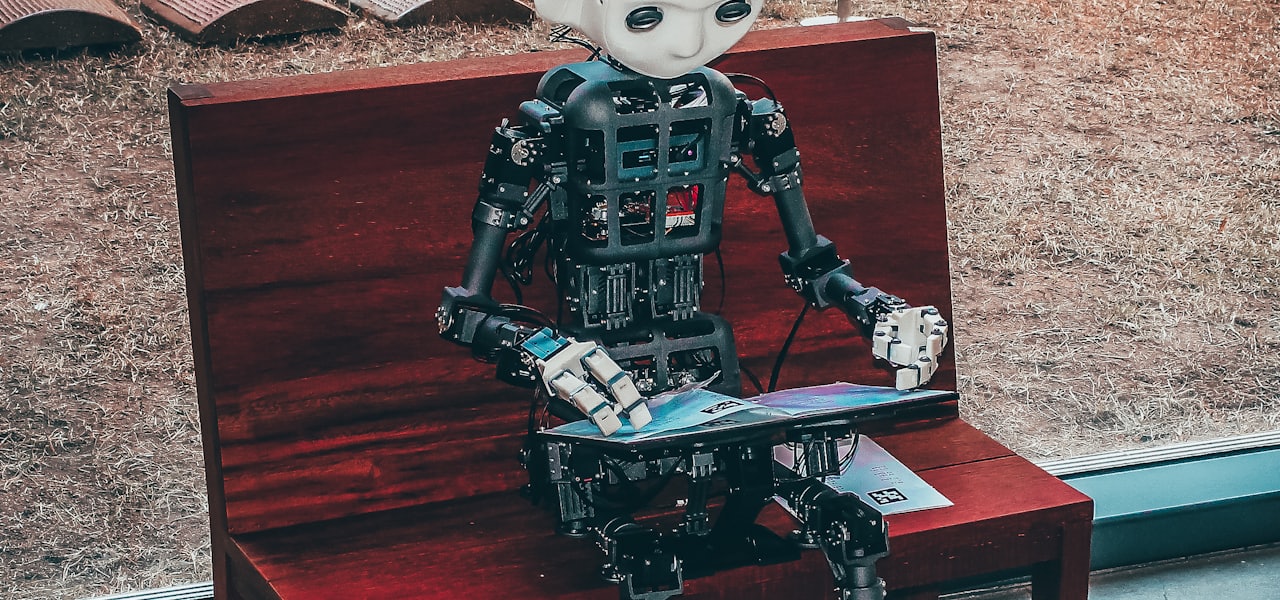
Artificial intelligence in education (often abbreviated as AIEd) is a subfield of educational technology that studies how to use artificial intelligence to create learning environments. Considerations in the field include data-driven decision-making, AI ethics, data privacy and AI literacy. Concerns include the potential for cheating, over-reliance, equity of access, reduced critical thinking, and the perpetuation of misinformation and bias. == History == Efforts to integrate AI into educational contexts have often followed technological advancement in the history of artificial intelligence. In the 1960s, educators and researchers began developing computer-based instruction systems, such as PLATO, developed by the University of Illinois. In the 1970s and 1980s, intelligent tutoring systems (ITS) were being adapted for classroom instruction. The International Artificial Intelligence in Education Society was founded in 1993. Coinciding with the AI boom of the 2020s, the use of large language models in the global north has been promoted and funded by venture capital and big tech. Companies creating AI services have targeted students and educational institutions as customers. Similarly, pre-AI boom educational companies have expanded their use of AI technologies. These commercial incentives for AIEd use may be related to a potential AI bubble. In the U.S., bipartisan support of AI development in K-12 education has been expressed, but specific implementations and best practices remain contentious. == Theory == AIEd applies theory from education studies, machine learning, and related fields. A 2019 review of the previous decade of studies found that most research prioritized technological design over pedagogical integration. Ouyang and Jiao (2021) propose three paradigms for AI in education, which follow roughly from least to most learner-centered and from requiring least to most technical complexity from the AI systems: AI-directed, learner-as-recipient: AIEd systems present a pre-set curriculum based on statistical patterns that do not adjust to learner's feedback. AI-supported, learner-as-collaborator: Systems that incorporate responsiveness to learner's feedback through, for example, natural language processing, wherein AI can support knowledge construction. AI-empowered, learner-as-leader: This model seeks to position AI as a supplement to human intelligence wherein learners take agency and AI provides consistent and actionable feedback. Some scholars place AI in education within a socio-technical framework. This positions AI alongside other emerging educational technologies, such as computing, the internet, and social media. The framework of Tsao, Heinrichs and Camit (2025) draws on new materialism and posthumanism, specifically Donna Haraway's concept of sympoiesis (making-with). This perspective views learning as an entanglement of human and non-human actors (students, teachers, and AI algorithms), where knowledge is co-composed in contact zones between human context and algorithmic prediction. AI agents have been trained on biased datasets, and thus continue to perpetuate societal biases. Since LLMs were created to produce human-like text, algorithmic bias can be introduced and reproduced. AI's data processing and monitoring reinforce neoliberal approaches to education rather than addressing inequalities. == Applications == Uses of generative AI chatbots in education have included assessment and feedback, machine translations, proof-reading exam question generation and copy editing, or as virtual assistants. Emotional AI in education is the study and development of systems that can detect learners' emotions or provide emotional support in learning. == Usage == === Schools and educators === Following the release of ChatGPT in November 2022, some schools and large school districts blocked access to the site and issued warnings that the use of such tools would be seen as cheating. Governmental and non-governmental organizations such as UNESCO, Article 4 of the European Union's AI Act, and the U.S. Department of Education have published reports advocating for specific AIEd approaches. National higher-education bodies have also published guidance on generative AI, including Ireland's Higher Education Authority, which issued a policy framework for higher education teaching and learning in December 2025. In 2024, UNESCO released updated global guidance for generative AI in education, emphasizing ethical use, teacher training, and data protection to ensure responsible integration of AI tools in learning environments. According to Taso (2025), policy implementation in higher education is interpreted and enacted differently by various organizations. These decentralized policies can lead to inconsistent enforcement and confusion among students regarding what constitutes acceptable use, with the burden of ethical navigation falling on individual teachers and students. AI integration in classrooms has created new forms of invisible labour for educators, who must navigate ambiguous policies, redesign assessments to be AI-resilient, and adjudicate potential academic integrity violations. The use of AI detection tools has also been criticised for creating an adversarial relationship between students and institutions, where students may be falsely accused of misconduct based on probabilistic software. AIEd advocates say that efforts should be made towards increasing global accessibility and training educators to serve underprivileged areas. === Students === Reliance on generative AI has been linked with reduced academic self-esteem and performance, and heightened learned helplessness. Algorithm errors and hallucinations are common flaws in AI agents, making them less trustworthy and reliable. According to a 2025 survey from Inside Higher Ed, 85% of higher education students use generative AI technology in some way, with 25% using AI to complete assignments for them. The most common reason cited for using AI to cheat was pressure to get high grades. 97% of students wanted some form of action from schools on the threat to academic integrity caused by AI, with the most popular options being clearer policies and more education about ethical uses of AI. In September 2025, The Atlantic published an op-ed from a high school senior arguing that the normalization of AI cheating was eroding critical thinking, academic integrity, creativity, and the shared student experience.
Automated machine learning
Automated machine learning (AutoML) is the process of automating the tasks of applying machine learning to real-world problems. It is the combination of automation and ML. AutoML potentially includes every stage from beginning with a raw dataset to building a machine learning model ready for deployment. AutoML was proposed as an artificial intelligence-based solution to the growing challenge of applying machine learning. The high degree of automation in AutoML aims to allow non-experts to make use of machine learning models and techniques without requiring them to become experts in machine learning. Automating the process of applying machine learning end-to-end additionally offers the advantages of producing simpler solutions, faster creation of those solutions, and models that often outperform hand-designed models. Common techniques used in AutoML include hyperparameter optimization, meta-learning and neural architecture search. == Comparison to the standard approach == In a typical machine learning application, practitioners have a set of input data points to be used for training. The raw data may not be in a form that all algorithms can be applied to. To make the data amenable for machine learning, an expert may have to apply appropriate data pre-processing, feature engineering, feature extraction, and feature selection methods. After these steps, practitioners must then perform algorithm selection and hyperparameter optimization to maximize the predictive performance of their model. If deep learning is used, the architecture of the neural network must also be chosen manually by the machine learning expert. Each of these steps may be challenging, resulting in significant hurdles to using machine learning. AutoML aims to simplify these steps for non-experts, and to make it easier for them to use machine learning techniques correctly and effectively. AutoML plays an important role within the broader approach of automating data science, which also includes challenging tasks such as data engineering, data exploration and model interpretation and prediction. == Targets of automation == Automated machine learning can target various stages of the machine learning process. Steps to automate are: Data preparation and ingestion (from raw data and miscellaneous formats) Column type detection; e.g., Boolean, discrete numerical, continuous numerical, or text Column intent detection; e.g., target/label, stratification field, numerical feature, categorical text feature, or free text feature Task detection; e.g., binary classification, regression, clustering, or ranking Feature engineering Feature selection Feature extraction Meta-learning and transfer learning Detection and handling of skewed data and/or missing values Model selection - choosing which machine learning algorithm to use, often including multiple competing software implementations Ensembling - a form of consensus where using multiple models often gives better results than any single model Hyperparameter optimization of the learning algorithm and featurization Neural architecture search Pipeline selection under time, memory, and complexity constraints Selection of evaluation metrics and validation procedures Problem checking Leakage detection Misconfiguration detection Analysis of obtained results Creating user interfaces and visualizations == Challenges and Limitations == There are a number of key challenges being tackled around automated machine learning. A big issue surrounding the field is referred to as "development as a cottage industry". This phrase refers to the issue in machine learning where development relies on manual decisions and biases of experts. This is contrasted to the goal of machine learning which is to create systems that can learn and improve from their own usage and analysis of the data. Basically, it's the struggle between how much experts should get involved in the learning of the systems versus how much freedom they should be giving the machines. However, experts and developers must help create and guide these machines to prepare them for their own learning. To create this system, it requires labor intensive work with knowledge of machine learning algorithms and system design. Additionally, other challenges include meta-learning and computational resource allocation.
AI Coding Assistants: Free vs Paid (2026)
In search of the best AI coding assistant? An AI coding assistant is software that uses machine learning to help you get more done — it turns a rough idea into a polished result in seconds. When choosing one, weigh output quality, pricing, export formats, and how well it fits the tools you already use. Whether you are a beginner or a pro, the right AI coding assistant slots into your workflow and pays for itself fast. Below we compare features, pricing, and real output so you can choose with confidence.
Language model
A language model is a computational model that predicts sequences in natural language. Language models are useful for a variety of tasks, including speech recognition, machine translation, natural language generation (generating more human-like text), optical character recognition, route optimization, handwriting recognition, grammar induction, information retrieval and disaster response. Large language models (LLMs), currently their most advanced form as of 2026, are predominantly based on transformers trained on larger datasets (frequently using texts scraped from the public internet). They have superseded recurrent neural network-based models, which had previously superseded the purely statistical models, such as the word n-gram language model. == History == Noam Chomsky did pioneering work on language models in the 1950s by developing a theory of formal grammars. In 1980, statistical approaches were explored and found to be more useful for many purposes than rule-based formal grammars. Discrete representations like word n-gram language models, with probabilities for discrete combinations of words, made significant advances. In the 2000s, continuous representations for words, such as word embeddings, began to replace discrete representations. Typically, the representation is a real-valued vector that encodes a word’s meaning such that words closer in vector space are similar in meaning and common relationships between words, such as plurality or gender, are preserved. == Pure statistical models == In 1980, the first significant statistical language model was proposed, and during the decade IBM performed 'Shannon-style' experiments, in which potential sources for language modeling improvement were identified by observing and analyzing the performance of human subjects in predicting or correcting text. === Models based on word n-grams === === Exponential === Maximum entropy language models encode the relationship between a word and the n-gram history using feature functions. The equation is P ( w m ∣ w 1 , … , w m − 1 ) = 1 Z ( w 1 , … , w m − 1 ) exp ( a T f ( w 1 , … , w m ) ) {\displaystyle P(w_{m}\mid w_{1},\ldots ,w_{m-1})={\frac {1}{Z(w_{1},\ldots ,w_{m-1})}}\exp(a^{T}f(w_{1},\ldots ,w_{m}))} where Z ( w 1 , … , w m − 1 ) {\displaystyle Z(w_{1},\ldots ,w_{m-1})} is the partition function, a {\displaystyle a} is the parameter vector, and f ( w 1 , … , w m ) {\displaystyle f(w_{1},\ldots ,w_{m})} is the feature function. In the simplest case, the feature function is just an indicator of the presence of a certain n-gram. It is helpful to use a prior on a {\displaystyle a} or some form of regularization. The log-bilinear model is another example of an exponential language model. === Skip-gram model === == Neural models == === Recurrent neural network === Continuous representations or embeddings of words are produced in recurrent neural network-based language models (known also as continuous space language models). Such continuous space embeddings help to alleviate the curse of dimensionality, which is the consequence of the number of possible sequences of words increasing exponentially with the size of the vocabulary, further causing a data sparsity problem. Neural networks avoid this problem by representing words as non-linear combinations of weights in a neural net. === Large language models === Although sometimes matching human performance, it is not clear whether they are plausible cognitive models. At least for recurrent neural networks, it has been shown that they sometimes learn patterns that humans do not, but fail to learn patterns that humans typically do. == Evaluation and benchmarks == Evaluation of the quality of language models is mostly done by comparison to human created sample benchmarks created from typical language-oriented tasks. Other, less established, quality tests examine the intrinsic character of a language model or compare two such models. Since language models are typically intended to be dynamic and to learn from data they see, some proposed models investigate the rate of learning, e.g., through inspection of learning curves. Various data sets have been developed for use in evaluating language processing systems. These include: Massive Multitask Language Understanding (MMLU) Corpus of Linguistic Acceptability GLUE benchmark Microsoft Research Paraphrase Corpus Multi-Genre Natural Language Inference Question Natural Language Inference Quora Question Pairs Recognizing Textual Entailment Semantic Textual Similarity Benchmark SQuAD question answering Test Stanford Sentiment Treebank Winograd NLI BoolQ, PIQA, SIQA, HellaSwag, WinoGrande, ARC, OpenBookQA, NaturalQuestions, TriviaQA, RACE, BIG-bench hard, GSM8k, RealToxicityPrompts, WinoGender, CrowS-Pairs
Anil K. Jain (computer scientist, born 1948)
Anil Kumar Jain (born 1948) is an Indian-American computer scientist and University Distinguished Professor in the Department of Computer Science and Engineering at Michigan State University. He is one of the most highly cited researchers in computer science, and is internationally recognized for his foundational contributions to pattern recognition, computer vision, and biometric recognition, particularly in fingerprint recognition and face recognition. Jain is a member of the United States National Academy of Engineering, a Foreign Member of the Chinese Academy of Sciences, and a Foreign Fellow of the Indian National Academy of Engineering. He is a Fellow of the ACM, IEEE, AAAS, IAPR, and SPIE. His research has shaped the field of biometrics and has been applied in systems used worldwide for identity verification, law enforcement, and border security. In 2024, he was awarded the BBVA Foundation Frontiers of Knowledge Award in the category of Information and Communication Technologies. == Early life and education == Born in Basti, India, Jain received his Bachelor of Technology in electrical engineering from the Indian Institute of Technology, Kanpur in 1969. He then moved to the United States, where he earned his M.S. in 1970 and Ph.D. in 1973 from Ohio State University. His doctoral dissertation, titled Some Aspects of Dimensionality and Sample Size Problems in Statistical Pattern Recognition, was supervised by Robert B. McGhee and laid the groundwork for his subsequent research in pattern recognition. == Career == Jain began his academic career at Wayne State University, where he taught from 1972 to 1974. In 1974, he joined the faculty of Michigan State University, where he has remained for over five decades and currently holds the position of University Distinguished Professor. Throughout his career, Jain has conducted pioneering research in data clustering, fingerprint recognition, and face recognition. His work has been published in leading scientific journals including Scientific American, Nature, IEEE Spectrum, and MIT Technology Review. He served as Editor-in-Chief of the IEEE Transactions on Pattern Analysis and Machine Intelligence from 1991 to 1994. Jain has also contributed to national security and policy through his service on several advisory bodies. He served as a member of the U.S. National Academies panels on Information Technology, Whither Biometrics, and Improvised Explosive Devices (IED). He has also served on the Defense Science Board, the Forensic Science Standards Board, and the AAAS Latent Fingerprint Working Group. In 2014, Jain was named Innovator of the Year at Michigan State University for transferring several technologies on face and fingerprint recognition to major players in the biometrics industry. He holds eight U.S. and Korean patents related to biometric technologies. == Research contributions == Jain's research spans pattern recognition, computer vision, machine learning, and biometric recognition. His contributions have been particularly influential in several areas: === Biometric recognition === Jain is considered one of the foremost authorities on biometric recognition systems. His research group at Michigan State University has developed algorithms and systems for fingerprint, face, and iris recognition that have been widely adopted in both academic research and commercial applications. His work on fingerprint matching algorithms has been instrumental in establishing standards for automated fingerprint identification systems (AFIS) used by law enforcement agencies worldwide. In recent years, Jain and his research team have made significant advances in child fingerprint recognition, demonstrating that digital scans of a young child's fingerprint can be correctly recognized one year later with over 99 percent accuracy for children as young as six months old. This research has important implications for child identification in developing countries, where it can be used to track immunization records and provide access to medical care. === Data clustering === Jain's survey article "Data clustering: a review" (1999), co-authored with M. N. Murty and P. J. Flynn, is one of the most highly cited papers in computer science. His 2010 paper "Data Clustering: 50 Years Beyond K-Means" provided a comprehensive overview of the evolution of clustering methods and remains an essential reference in the field. === Statistical pattern recognition === Jain's work on statistical pattern recognition, including his influential survey "Statistical pattern recognition: A review" (2000) with R. P. W. Duin and Jianchang Mao, has shaped the theoretical foundations of the field. == Citation metrics and academic impact == Jain is among the most highly cited researchers in computer science. Based on his Google Scholar profile, he had an h-index of 200 in 2020, which was the highest among computer scientists identified in a survey published by UCLA at the time. As of August 2023, his h-index on Google Scholar is 211. He has since been surpassed by Yoshua Bengio, a researcher of similar subjects (neural networks and deep learning for artificial intelligence), who had an h-index of 224 as of August 2023. Another source reported that as of December 2022, he had the highest discipline h-index (D-index) in computer science. == Honors and awards == Jain has received numerous awards and honors recognizing his contributions to computer science and engineering: === Academy memberships === Member, United States National Academy of Engineering (2016) — elected "for contributions to the engineering and practice of biometrics" Foreign Fellow, Indian National Academy of Engineering (2016) Foreign Member, Chinese Academy of Sciences (2019) Member, The World Academy of Sciences (2019) Fellow, National Academy of Inventors === Professional society fellowships === Fellow, ACM Fellow, IEEE (1988) — for contributions to image processing Fellow, AAAS Fellow, International Association for Pattern Recognition Fellow, SPIE === Major awards === BBVA Foundation Frontiers of Knowledge Award in Information and Communication Technologies (2024) IAPR King-Sun Fu Prize (2008) IEEE W. Wallace McDowell Award (2007) — the highest technical honor awarded by the IEEE Computer Society, for pioneering contributions to theory, technique, and practice of pattern recognition, computer vision, and biometric recognition systems IEEE Computer Society Technical Achievement Award (2003) IAPR Pierre Devijver Award (2002) Humboldt Research Award (2002) Guggenheim Fellowship (2001) Fulbright Fellowship (1998) IEEE ICDM Research Contribution Award (2008) === Best paper awards === IEEE Transactions on Neural Networks (1996) Pattern Recognition journal (1987, 1991, 2005) === Honorary doctorates === Universidad Autónoma de Madrid (2018) Hong Kong University of Science and Technology (2021) == Legacy and endowments == Two endowed funds have been established in Jain's honor at Michigan State University, recognizing his lasting impact on the field and the university. In 2015, a former visiting scholar from Jain's laboratory made an anonymous $400,000 gift to create the Anil K. Jain Endowed Graduate Fellowship, which supports doctoral-level research in pattern recognition, computer vision, and biometric recognition. In 2022, the Anil K. and Nandita K. Jain Endowed Professorship was established through $1 million in contributions from multiple donors, including a substantial gift from the Jain family, to support faculty recruitment and retention in the Department of Computer Science and Engineering. == Selected publications == === Books === 1988. Algorithms For Clustering Data. With Richard C. Dubes. Prentice Hall. 1993. Markov Random Fields: Theory and Applications. With Rama Chellappa eds. Academic Press. 1999. Biometrics: Personal Identification in Networked Society. With Ruud M. Bolle and Sharath Pankanti eds. Springer. 2003. Handbook of Fingerprint Recognition. (2nd edition 2009). With D. Maio, D. Maltoni, S. Prabhakar. Springer. 2005. Handbook of Face Recognition. (2nd edition 2011). With S. Z. Li ed. Springer. 2006. Handbook of Multibiometrics. With A. Ross and K. Nandakumar. Springer. 2007. Handbook of Biometrics. With P. Flynn and A. Ross eds. Springer. 2011. Introduction to Biometrics. With A. Ross and K. Nandakumar. Springer. 2015. Encyclopedia of Biometrics (Second Edition). With Stan Li. Springer. === Research articles === Cross, George R. and Anil K. Jain. "Markov random field texture models". IEEE Transactions on Pattern Analysis and Machine Intelligence (1983): 25–39. Jain, Anil K., and Farshid Farrokhnia. "Unsupervised texture segmentation using Gabor filters". Pattern Recognition 24.12 (1991): 1167–1186. Jain, Anil K., and Douglas Zongker. "Feature selection: Evaluation, application, and small sample performance". IEEE Transactions on Pattern Analysis and Machine Intelligence, 19.2 (1997): 153–158. Jain, Anil K., L. Hong, S. Pankanti, R. Bolle. "An Identity-A
Zeuthen strategy
The Zeuthen strategy in cognitive science is a negotiation strategy used by some artificial agents. Its purpose is to measure the willingness to risk conflict. An agent will be more willing to risk conflict if it does not have much to lose in case that the negotiation fails. In contrast, an agent is less willing to risk conflict when it has more to lose. The value of a deal is expressed in its utility. An agent has much to lose when the difference between the utility of its current proposal and the conflict deal is high. When both agents use the monotonic concession protocol, the Zeuthen strategy leads them to agree upon a deal in the negotiation set. This set consists of all conflict free deals, which are individually rational and Pareto optimal, and the conflict deal, which maximizes the Nash product. The strategy was introduced in 1930 by the Danish economist Frederik Zeuthen. == Three key questions == The Zeuthen strategy answers three open questions that arise when using the monotonic concession protocol, namely: Which deal should be proposed at first? On any given round, who should concede? In case of a concession, how much should the agent concede? The answer to the first question is that any agent should start with its most preferred deal, because that deal has the highest utility for that agent. The second answer is that the agent with the smallest value of Risk(i,t) concedes, because the agent with the lowest utility for the conflict deal profits most from avoiding conflict. To the third question, the Zeuthen strategy suggests that the conceding agent should concede just enough raise its value of Risk(i,t) just above that of the other agent. This prevents the conceding agent to have to concede again in the next round. == Risk == Risk ( i , t ) = { 1 U i ( δ ( i , t ) ) = 0 U i ( δ ( i , t ) ) − U i ( δ ( j , t ) ) U i ( δ ( i , t ) ) otherwise {\displaystyle {\text{Risk}}(i,t)={\begin{cases}1&U_{i}(\delta (i,t))=0\\{\frac {U_{i}(\delta (i,t))-U_{i}(\delta (j,t))}{U_{i}(\delta (i,t))}}&{\text{otherwise}}\end{cases}}} Risk(i,t) is a measurement of agent i's willingness to risk conflict. The risk function formalizes the notion that an agent's willingness to risk conflict is the ratio of the utility that agent would lose by accepting the other agent's proposal to the utility that agent would lose by causing a conflict. Agent i is said to be using a rational negotiation strategy if at any step t + 1 that agent i sticks to his last proposal, Risk(i,t) > Risk(j,t). == Sufficient concession == If agent i makes a sufficient concession in the next step, then, assuming that agent j is using a rational negotiation strategy, if agent j does not concede in the next step, he must do so in the step after that. The set of all sufficient concessions of agent i at step t is denoted SC(i, t). == Minimal sufficient concession == δ ′ = arg max δ ∈ S C ( A , t ) { U A ( δ ) } {\displaystyle \delta '=\arg \max _{\delta \in {SC(A,t)}}\{U_{A}(\delta )\}} is the minimal sufficient concession of agent A in step t. Agent A begins the negotiation by proposing δ ( A , 0 ) = arg max δ ∈ N S U A ( δ ) {\displaystyle \delta (A,0)=\arg \max _{\delta \in {NS}}U_{A}(\delta )} and will make the minimal sufficient concession in step t + 1 if and only if Risk(A,t) ≤ Risk(B,t). Theorem If both agents are using Zeuthen strategies, then they will agree on δ = arg max δ ′ ∈ N S { π ( δ ′ ) } , {\displaystyle \delta =\arg \max _{\delta '\in {NS}}\{\pi (\delta ')\},} that is, the deal which maximizes the Nash product. Proof Let δA = δ(A,t). Let δB = δ(B,t). According to the Zeuthen strategy, agent A will concede at step t {\displaystyle t} if and only if R i s k ( A , t ) ≤ R i s k ( B , t ) . {\displaystyle Risk(A,t)\leq Risk(B,t).} That is, if and only if U A ( δ A ) − U A ( δ B ) U A ( δ A ) ≤ U B ( δ B ) − U B ( δ A ) U B ( δ B ) {\displaystyle {\frac {U_{A}(\delta _{A})-U_{A}(\delta _{B})}{U_{A}(\delta _{A})}}\leq {\frac {U_{B}(\delta _{B})-U_{B}(\delta _{A})}{U_{B}(\delta _{B})}}} U B ( δ B ) ( U A ( δ A ) − U A ( δ B ) ) ≤ U A ( δ A ) ( U B ( δ B ) − U B ( δ A ) ) {\displaystyle U_{B}(\delta _{B})(U_{A}(\delta _{A})-U_{A}(\delta _{B}))\leq U_{A}(\delta _{A})(U_{B}(\delta _{B})-U_{B}(\delta _{A}))} U A ( δ A ) U B ( δ B ) − U A ( δ B ) U B ( δ B ) ≤ U A ( δ A ) U B ( δ B ) − U A ( δ A ) U B ( δ A ) {\displaystyle U_{A}(\delta _{A})U_{B}(\delta _{B})-U_{A}(\delta _{B})U_{B}(\delta _{B})\leq U_{A}(\delta _{A})U_{B}(\delta _{B})-U_{A}(\delta _{A})U_{B}(\delta _{A})} − U A ( δ B ) U B ( δ B ) ≤ − U A ( δ A ) U B ( δ A ) {\displaystyle -U_{A}(\delta _{B})U_{B}(\delta _{B})\leq -U_{A}(\delta _{A})U_{B}(\delta _{A})} U A ( δ A ) U B ( δ A ) ≤ U A ( δ B ) U B ( δ B ) {\displaystyle U_{A}(\delta _{A})U_{B}(\delta _{A})\leq U_{A}(\delta _{B})U_{B}(\delta _{B})} π ( δ A ) ≤ π ( δ B ) {\displaystyle \pi (\delta _{A})\leq \pi (\delta _{B})} Thus, Agent A will concede if and only if δ A {\displaystyle \delta _{A}} does not yield the larger product of utilities. Therefore, the Zeuthen strategy guarantees a final agreement that maximizes the Nash Product.
Interactive machine translation
Interactive machine translation (IMT), is a specific sub-field of computer-aided translation. Under this translation paradigm, the computer software that assists the human translator attempts to predict the text the user is going to input by taking into account all the information it has available. Whenever such prediction is wrong and the user provides feedback to the system, a new prediction is performed considering the new information available. Such process is repeated until the translation provided matches the user's expectations. Interactive machine translation is specially interesting when translating texts in domains where it is not admissible to output a translation containing errors, hence requiring a human user to amend the translations provided by the system. In such cases, interactive machine translation has been proved to provide benefit to potential users. Nevertheless, there are few commercial software that implements interactive machine translation and work done in the field is mostly restrained to academic research. == History == Historically, interactive machine translation is born as an evolution of the computer-aided translation paradigm, where the human translator and the machine translation system were intended to work as a tandem. This first work was extended within the TransType research project, funded by the Canadian government. In this project, the human interaction was aimed towards producing the target text for the first time by embedding data-driven machine translation techniques within the interactive translation environment with the goal of achieving the best of both actors: the efficiency of the automatic system and the reliability of human translators. Later, a larger-scale research project, TransType2, funded by the European Commission extended such work by analyzing the incorporation of a complete machine translation system into the process, with the goal of producing a complete translation hypothesis, which the human user is allowed to amend or accept. If the user decides to amend the hypothesis, the system then attempts to make the best use of such feedback in order to produce a new translation hypothesis that takes into account the modifications introduced by the user. More recently, CASMACAT, also funded by the European Commission, aimed at developing novel types of assistance to human translators and integrated them into a new workbench, consisting of an editor, a server, and analysis and visualisation tools. The workbench was designed in a modular fashion and can be combined with existing computer aided translation tools. Furthermore, the CASMACAT workbench can learn from the interaction with the human translator by updating and adapting its models instantly based on the translation choices of the user. Recent work on involving an extensive evaluation with human users revealed the fact that interactive machine translation may even be used by users that do not speak the source language in order to achieve near professional translation quality. Moreover, it also elucidated the fact that an interactive scenario is more beneficial than a classic post-edition scenario. The previously described approaches rely on a tightly coupled underlying corpus-based machine translation system (usually, a Statistical machine translation system) that is used as a glass box, therefore inheriting the shortcomings of the translation systems and limiting the usage of interactive machine translation for some scenarios. For this reason, an approach that uses any kind of bilingual resource (not limited to machine translation) as a black-box to provide interactive machine translation was developed. This approach is not able to extract as much information from the bilingual resources used, due to the black-box nature of the interaction, but can use any resource available to the user. Forecat is a black-box interactive machine translation implementation that is available both as a web application (that includes a webpage and a web services interface) and as a plugin for OmegaT (Forecat-OmegaT). == Process == The interactive machine translation process starts with the system suggesting a translation hypothesis to the user. Then, the user may accept the complete sentence as correct, or may modify it if he considers there is some error. Typically, when modifying a given word, it is assumed that the prefix until that word is correct, leading to a left-to-right interaction scheme. Once the user has changed the word considered incorrect, the system then proposes a new suffix, i.e. the remainder of the sentence. Such process continues until the translation provided satisfies the user. Although explained at the word level, the previous process may also be implemented at the character level, and hence the system provides a suffix whenever the human translator types in a single character. In addition, there is ongoing effort towards changing the typical left-to-right interaction scheme in order to make human-machine interaction easier. A similar approach is used in the Caitra translation tool. == Evaluation == Evaluation is a difficult issue in interactive machine translation. Ideally, evaluation should take place in experiments involving human users. However, given the high monetary cost this would imply, this is seldom the case. Moreover, even when considering human translators in order to perform a true evaluation of interactive machine translation techniques, it is not clear what should be measured in such experiments, since there are many different variables that should be taken into account and cannot be controlled, as is for instance the time the user takes in order to get used to the process. In the CASMACAT project, some field trials have been carried out to study some of these variables. For quick evaluations in laboratory conditions, interactive machine translation is measured by using the key stroke ratio or the word stroke ratio. Such criteria attempt to measure how many key-strokes or words did the user need to introduce before producing the final translated document. == Differences with classical computer-aided translation == Although interactive machine translation is a sub-field of computer-aided translation, the main attractive of the former with respect to the latter is the interactivity. In classical computer-aided translation, the translation system may suggest one translation hypothesis in the best case, and then the user is required to post-edit such hypothesis. In contrast, in interactive machine translation the system produces a new translation hypothesis each time the user interacts with the system, i.e. after each word (or letter) has been introduced.